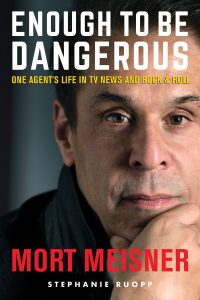
Many of us remember the first time we saw a musical act that transformed us. For TV news talent agent Mort Meisner, it was Bruce Springsteen.
In fact, Mort would hold the record in Michigan for attending the most Springsteen concerts, were it not for 97.1 The Ticket radio personality Mike Stone.
But that’s okay. It’s not a competition. They both share a fierce passion for both Springsteen’s music, as well as for the musician and everything he represents. In fact, Mort is such a diehard fan that he committed two chapters to ‘The Boss’ in his memoir, Enough to Be Dangerous.
You Never Forget Your First Time
Mort had never heard of Bruce Springsteen that fateful night he went to see him in September of 1975 at the age of 22. He recalls that he felt more like a young teenager, sitting front and center and waiting to see this “Bruce Springsteen guy” come on stage. He had no idea what to expect.
Before I knew it, there he was, playing Incident on 57th Street. He went through his array of songs—none of which I’d heard—including Born to Run. I was blown away.
For Mort, and presumably the rest of the audience, Born to Run was an anthem for escape and hope. And it resonated deeply during a time of economic hardship and social upheaval. Springsteen was a true storyteller. And he was a rising voice for the working class.
Mort was a rock and roll promoter in Detroit at the time and knew immediately he had to book Springsteen at the Michigan Palace. So he went to talk to Springsteen’s manager. Two weeks later, Springsteen was on stage there. Thus began Mort’s journey toward becoming a Bruce Springsteen groupie.
Following the Boss
Mort’s friend Nelson was equally taken by Springsteen. So the two of them set out to travel around the country to see him perform. On one occasion, they went to Asbury Park, New Jersey, in hopes of catching Springsteen slumming at the famous Stone Pony. It took some finagling. After a visit to sax man extraordinaire Clarence Clemons’ home and several more attempts at the Stone Pony, they finally scored.
Springsteen treated them like royalty. He was genuinely interested in their stories and curious about why they’d come all that way. Then he proceeded to play there for an hour and a half in what was almost a private concert.
Listening to him perform, I felt profoundly different. I can’t really explain it. I thought, this guy is like Bob Dylan. But different. More upbeat. More spiritual, maybe? The way I interpreted his songs resonated with something deep inside me. He ran sentences and words together which I didn’t understand, but I did not need to understand. He seemed to be able to articulate the collective aspirations of his entire audience. And yet, he got ME. Individually.
It became another life-changing night for Mort.
Still Loving Bruce Springsteen
In his memoir, Mort recounts a childhood riddled with violence and abuse. He lived his young adult years hard and fast, eventually succumbing to drug use in an attempt to outrun the demons that haunted him. But there was always one thing he knew could bring him back to center.
Over the years, from then until now, I’ve seen Bruce Springsteen 143 times. Even when I had tragedies and losses in my family, I always took solace in listening to Bruce. He was, and IS, always there as a salve or balm to bring me relief.
His abiding faith in Bruce Springsteen remains to this day. And why not? In these tumultuous times, Springsteen continues to use his platform to advocate for social justice and economic equality. He’s always been the first to participate in benefit concerts, support labor unions, and speak against economic disparities. And his commitment to these causes is evident in his music and public appearances, where he often highlights the need for systemic change. Most recently, he released his song “Streets of Minneapolis” as a response to fatal shootings by federal ICE agents in Minnesota, describing their tactics as “Gestapo tactics” and calling for accountability.
Even after fifty years in the music business, Bruce Springsteen’s music continues to inspire discussions of economic inequality, social justice, and political responsibility at a time when they’re needed more than ever.
Mort Thanks Bruce Springsteen for His Courage
Mort Meisner felt in only appropriate that his give another callout to Bruce Springsteen. Along with the social justice angle, Springsteen’s sheer willingness to explore new themes and sounds maintains his relevance and influence as a pivotal figure in rock music history.
As someone with deep working-class roots and a passion for social justice, Mort is beyond grateful.